100% Pass Useful Linux Foundation - Test CKAD Questions Fee
Wiki Article
P.S. Free & New CKAD dumps are available on Google Drive shared by TestInsides: https://drive.google.com/open?id=1t6uaEHM5pCXajNBZM9TbyDofMIXixOw3
Though there are three versions of the CKAD practice copyright: the PDF, Software and APP online, i love the PDF version the most for its printable advantage which is unique and special. After printing, you not only can bring the CKAD study materials with you wherever you go, but also can make notes on the paper at your liberty, which may help you to understand the contents of our CKAD Learning Materials. Do not wait and hesitate any longer, your time is precious!
Linux Foundation CKAD (Linux Foundation Certified Kubernetes Application Developer) Certification Exam is a highly sought-after certification for developers who are looking to prove their expertise in designing, building, configuring, and deploying cloud-native applications using Kubernetes. CKAD exam is designed to test the candidate’s skills in Kubernetes architecture, application design, troubleshooting, and security. Linux Foundation Certified Kubernetes Application Developer Exam certification is vendor-neutral, and candidates can take the exam from any location at any time, making it accessible to professionals all over the world.
2026 Linux Foundation CKAD: Linux Foundation Certified Kubernetes Application Developer Exam Fantastic Test Questions Fee
Students often feel helpless when purchasing test materials, because most of the test materials cannot be read in advance, students often buy some products that sell well but are actually not suitable for them. But if you choose CKAD test prep, you will certainly not encounter similar problems. Before you buy CKAD learning question, you can log in to our website to download a free trial question bank, and fully experience the convenience of PDF, APP, and PC three models of CKAD learning question. During the trial period, you can fully understand our study materials' learning mode, completely eliminate any questions you have about CKAD test prep, and make your purchase without any worries.
The CKAD Certification is an industry-recognized credential that can help developers advance their careers. Employers value the CKAD certification because it demonstrates that a developer has the skills and knowledge necessary to work with Kubernetes. Linux Foundation Certified Kubernetes Application Developer Exam certification can also increase a developer's earning potential and open up new job opportunities.
Linux Foundation Certified Kubernetes Application Developer Exam Sample Questions (Q162-Q167):
NEW QUESTION # 162
You have a stateful set named 'mysql-statefulset' that runs a MySQL database. The database data is stored in a PersistentV01umeClaim (PVC) named 'mysql-pvc' _ You want to ensure that the PVC is always mounted to the same pod, even after a pod restart or replacement. Additionally, you want to configure the PVC to use a specific storage class tor data persistence.
Answer:
Explanation:
See the solution below with Step by Step Explanation.
Explanation:
Solution (Step by Step) :
1. Create a Storage Class:
- Create a storage class YAML file with the desired storage class name and parameters, such as 'accessModes', 'reclaimPolicy' , and 'provisioner'.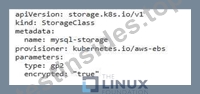
- Apply the YAML file using 'kubectl apply -f mysql-storage.yaml' 2. Create a PersistentVolumeClaim: - Create a PVC YAML file With the storage class defined, and specify the storage size and access modes for the PVC.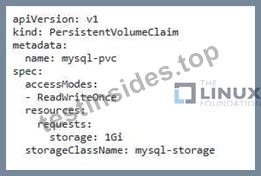
- Apply the YAML file using 'kubectl apply -f mysql-pvc.yamr 3. Define the StatefulSet: - Update the 'mysql-statefulset' YAML file: - Set the 'spec-template-spec-containers-volumeMounts' to mount the 'mysql-pvc' volume to the container- - Define a 'spec-volumeClaimTemplates' section to define the volume claim associated with the StatefulSet.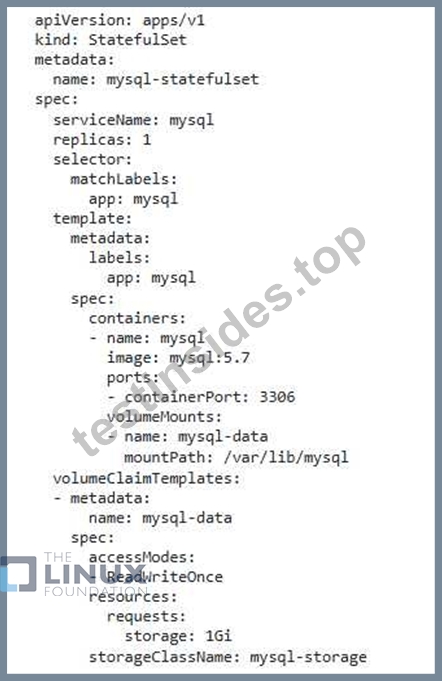
- Apply the YAML file using 'kubectl apply -f mysql-statefulset.yamr 4. Verify the StatefulSet: - Check the status of the StatefulSet using 'kubectl get sts mysql-statefulset' - Use ' kubectl describe pod mysql-o' to verify that the 'mysql-pvc' is mounted to the pod and the storage class is being used 5. Test Pod Replacement: - Delete a pod within the StatefulSet (e.g., 'kubectl delete pod mysql-O'). - Observe that a new pod is automatically created witn the same name Cmysql-ff) and the 'mysql-pvc' is mounted to it. 6. Monitor the Database: - Connect to the MySQL database using the 'kubectl exec' command and verify that the data is preserved even after a pod restan or replacement. These steps ensure that your mysql-statefulset utilizes a specific storage class for data persistence and the PVC is always mounted to the same pod, providing consistent data access. ,
NEW QUESTION # 163 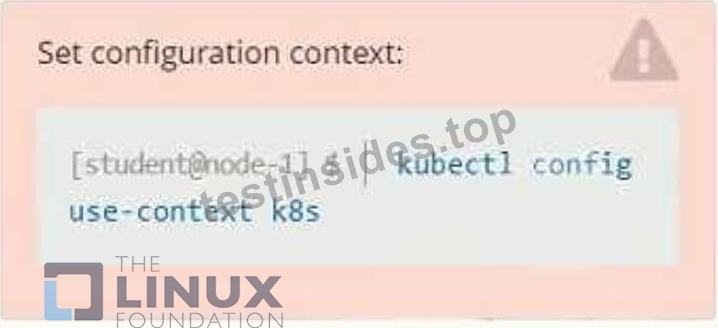
Context
As a Kubernetes application developer you will often find yourself needing to update a running application.
Task
Please complete the following:
* Update the app deployment in the kdpd00202 namespace with a maxSurge of 5% and a maxUnavailable of
2%
* Perform a rolling update of the web1 deployment, changing the Ifccncf/ngmx image version to 1.13
* Roll back the app deployment to the previous version
Answer:
Explanation:
See the solution below.
Explanation
Solution:
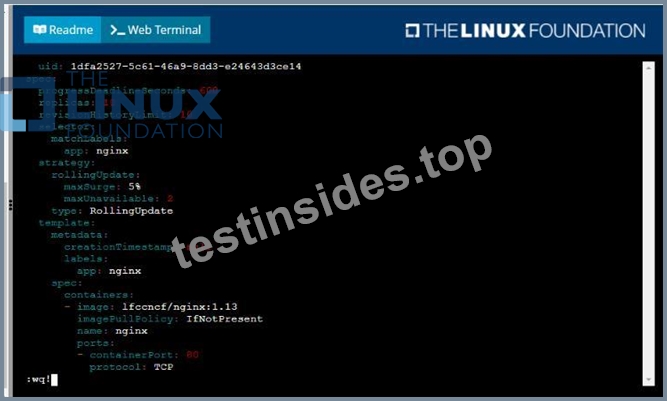
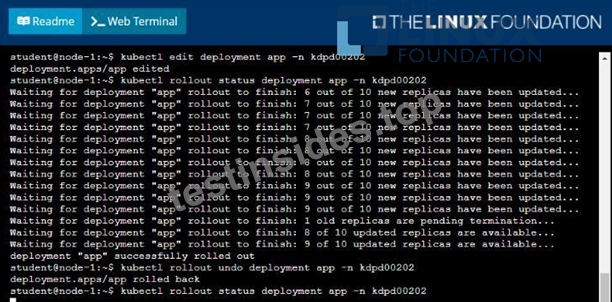
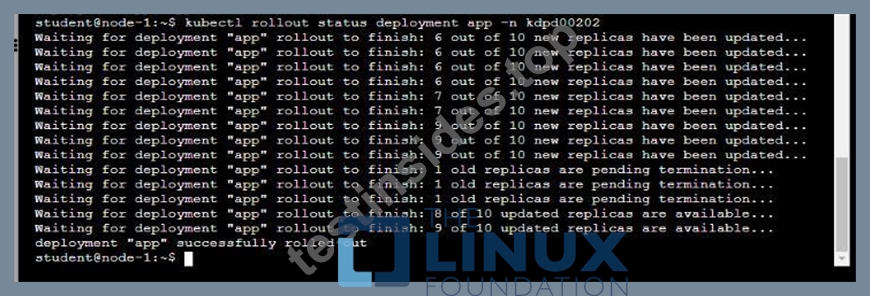
NEW QUESTION # 164
You have a Deployment named 'my-app' that runs 3 replicas of a Python application. You need to implement a bluetgreen deployment strategy where only a portion of the traffic is directed to the new version of the application initially. After successful validation, you want to gradually shift traffic to the new version until all traffic is directed to it. You'll use a new image tagged for the new version.
Answer:
Explanation:
See the solution below with Step by Step Explanation.
Explanation:
Solution (Step by Step) :
1. Create a new Deployment for the new version:
- Create a new Deployment file called 'my-app-v2.yaml'
- Define the 'replicas' to be the same as the original Deployment.
- Set the 'image' to 'my-app:v2'
- Ensure the 'metadata-name' is different from the original deployment.
- Use the same 'selector.matchLabelS as the original Deployment.
- Create the Deployment using 'kubectl apply -f my-app-v2.yaml'.
2. Create a Service for tne new Deployment: - Create a new Service file called 'my-app-v2-service.yaml'. - Define the 'selector' to match the labels of the 'my-app-v2 Deployment. - Set the 'type' to 'LoadBalancer' or 'NodePort' (depending on your environment) to expose the service. - Create the Service using 'kubectl apply -f my-app-v2-service.yaml"
3. Create an Ingress (or Route) for traffic routing: - Create an Ingress (or Route) file called 'my-app-ingress.yaml' - Define the 'host' to match your domain or subdomain. - Use a 'rules' section with two 'http' rules: one for the original Deployment C my-app-service' in this example) and one tor the new Deployment my- app-v2-service' in this example). - Define a 'path' for each rule to define the traffic routing. For example, you could route 'r to 'my-app-service' and ','v2 to 'my-app-v2-services - Create the Ingress (or Route) using 'kubectl apply -f my-app-ingress.yaml'
4. Test the new version: - Access the my-app.example.com/v2 endpoint to test the new version of your application. - Validate the functionality of the new version. 5. Gradually shift traffic: - You can adjust the 'path' rules in the Ingress (or Route) to gradually shift traffic to the new version. For example, you could define a 'path' like S/v2/beta' and then later change it to '/v2 - Alternatively, you can use a LoadBalancer controller like Kubernetes Ingress Controller (Nginx or Traefik) to configure traffic splitting using weights or headers. 6. Validate the transition: - Continue monitoring traffic and application health during the gradual shift. - Ensure a smooth transition to the new version without impacting users. 7. Delete the old Deployment and Service: - Once all traffic is shifted to the new version and you are confident in its performance, delete the old Deployment and Service C kubectl delete deployment my-app' and 'kubectl delete service my-app-service') to complete the blue/green deployment process. Note: This is a simplified example. In a real production environment, you would likely need to implement additional steps for: - Health checks: Ensure the new version is healthy before shifting traffic. - Rollback: Implement a rollback mechanism to quickly revert to the previous version if needed. - Configuration management: Store and manage configuration settings consistently across deployments. - Monitoring and logging: Monitor the new version for performance and health issues. ,
NEW QUESTION # 165
You are building a microservice that relies on a third-party API for its functionality_ To ensure the reliability and performance of your microservice, you need to implement a robust strategy tor handling API calls. Design a deployment strategy that addresses potential issues with the third-pany API and ensures the stability of your microservice.
Answer:
Explanation:
See the solution below with Step by Step Explanation.
Explanation:
Solution (Step by Step) :
I). Use a Deployment:
- Deploy your microservice using a Deployment. Deployments provide a robust mechanism for managing and scaling your microservices, making it easy to update and manage your application.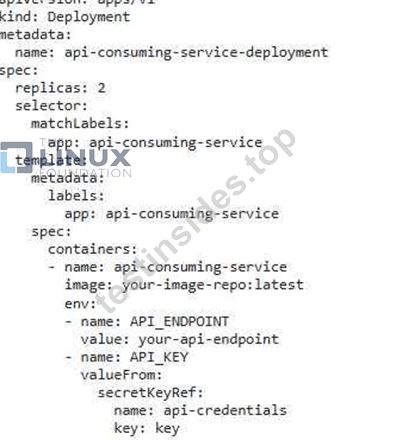
2. Secure API Credentials: - Store API credentials (like API keys or tokens) securely using a Kubernetes Secret. This prevents credentials from being exposed in plain text within your deployments.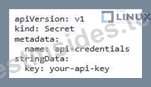
3. Implement Retry Mechanisms: - Add retry logic to your code to handle transient errors (like network hiccups or temporary service outages) during API calls. This helps ensure that your microservice can recover from temporary issues and continue functioning. 4. Utilize Rate Limiting: - Implement rate limiting to prevent your microservice from ovenvhelming the third-party API. This helps protect both your microservice and the API from performance degradation- 5. Use a Circuit Breaker Pattern: - Integrate a circuit breaker pattern into your API call handling. This pattern helps prevent cascading failures by automatically stopping requests to the third-party API it it is experiencing prolonged outages or errors- 6. Consider a Proxy or Gateway: - Implement a proxy or gateway layer between your microservice and the third-party API. This layer can help with request routing, load balancing, security, and performance optimization. 7. Monitor API Calls: - Implement monitoring and logging to track API call performance and identify potential issues. This allows you to proactively identify and address problems before they impact your microservice's reliability 8. Utilize Caching: - Consider caching API responses to reduce the load on the third-party API and improve the response time of your microservice. 9. Implement Fallbacks: - Have fallback mechanisms in place if the third-party API is unavailable. This could involve returning default data or using alternative data sources to provide a degraded but functional experience. 10. Consider Using a Service Mesh: - For complex microservice architectures, consider implementing a service mesh like Istio. Service meshes provide features like traffic management, security, observability, and resilience, which can be very beneficial for managing interactions with third-party APIs.,
NEW QUESTION # 166
You have a Deployment running a container image for a web application. The application's configuration files are currently stored within the image itself. you want to move the configuration files to a ConfigMap so that they can be updated independently or the application image. Describe the steps involved in modifying the Deployment and creating a ConfigMap to achieve this separation.
Answer:
Explanation:
See the solution below with Step by Step Explanation.
Explanation:
Solution (Step by Step) :
1. Create a ConfigMap:
- Create a ConfigMap using 'kubectl create configmap' with the configuration files. For example:
kubectl create configmap webapp-config -from-literal=config.json='{"port": 8080, "database_url": "mongodb://localhost27017"}'
- Replace 'config_json' with the name of your configuration file and the JSON content with your actual configuration values.
2. Modify the Deployment:
- Modify your Deployment YAML file to mount the ConfigMap as a volume. Here's an example: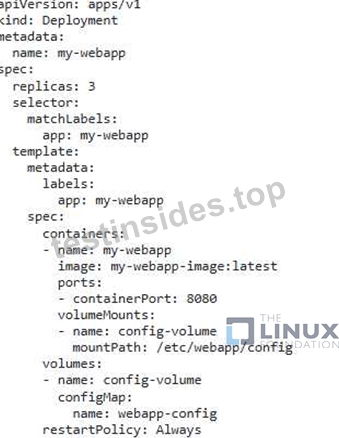
- Modify your application code to read configuration files from '/etctwebapp/config' 3. Apply the Changes: - Apply the updated Deployment using 'kubectl apply -f deployment_yamr 4. Verify the Update: - Check the logs of the pods using 'kubectl logs -f You should see the application loading configuration values from the ConfigMap. 5. Update the Configuration: - You can now update the configuration files within the ConfigMap without rebuilding the image. For example.
- This will update the ConfigMap and trigger a rolling update of the Deployment, effectively updating the application configuration without rebuilding the image.
NEW QUESTION # 167
......
CKAD Reliable Study Notes: https://www.testinsides.top/CKAD-dumps-review.html
- New CKAD Exam Testking ❎ Reliable CKAD Test Testking ???? Valid copyright CKAD Free ???? Download ▛ CKAD ▟ for free by simply entering ⇛ www.prepawaypdf.com ⇚ website ????Valid CKAD Test Sample
- Test CKAD Dumps ???? CKAD Training Pdf ???? New CKAD Exam Testking ⛴ Simply search for 《 CKAD 》 for free download on { www.pdfvce.com } ????Valid CKAD Test Sample
- CKAD Training Pdf ???? CKAD Latest Exam Tips ???? copyright CKAD Pdf ???? Search for ☀ CKAD ️☀️ and download exam materials for free through ➡ www.pdfdumps.com ️⬅️ ????CKAD Valid Test Vce Free
- Pass Guaranteed Quiz Latest Linux Foundation - Test CKAD Questions Fee ❎ Go to website ⇛ www.pdfvce.com ⇚ open and search for { CKAD } to download for free ????Pdf CKAD copyright
- Test CKAD Questions Fee|Cogent for Linux Foundation Certified Kubernetes Application Developer Exam ???? Search on { www.prep4away.com } for ⮆ CKAD ⮄ to obtain exam materials for free download ????CKAD Latest Materials
- 100% Pass 2026 Linux Foundation CKAD: Linux Foundation Certified Kubernetes Application Developer Exam –Trustable Test Questions Fee ???? Download ➡ CKAD ️⬅️ for free by simply entering ( www.pdfvce.com ) website ????Valid CKAD Test Sample
- Smashing CKAD Guide Materials: Linux Foundation Certified Kubernetes Application Developer Exam Deliver You Unique Exam copyright - www.dumpsquestion.com ???? Download 【 CKAD 】 for free by simply searching on ➡ www.dumpsquestion.com ️⬅️ ⭐Valid copyright CKAD Free
- Test CKAD Dumps ✳ Valid copyright CKAD Free ???? Valid CKAD Test Sample ???? Search for “ CKAD ” and obtain a free download on ✔ www.pdfvce.com ️✔️ ????CKAD New copyright Files
- CKAD Testing Center ???? Valid copyright CKAD Free ???? New CKAD Exam Testking ???? Download { CKAD } for free by simply searching on ➤ www.validtorrent.com ⮘ ????Pdf CKAD copyright
- Valid copyright CKAD Free ???? New CKAD Exam Testking ???? PDF CKAD Cram Exam ???? Open ➤ www.pdfvce.com ⮘ enter ⏩ CKAD ⏪ and obtain a free download ????New CKAD Exam Testking
- CKAD copyright Downloads ???? Reliable CKAD Test Testking ???? Valid copyright CKAD Free ???? Search for 【 CKAD 】 and download it for free on ✔ www.examcollectionpass.com ️✔️ website ????CKAD Best Preparation Materials
- classifylist.com, free-bookmarking.com, honeyddab058512.blogcudinti.com, woodylexg524053.blogginaway.com, lucykbfb182803.oneworldwiki.com, margiedanu893334.hamachiwiki.com, iwanzbes894081.techionblog.com, izaakawab987493.nizarblog.com, cool-directory.com, saulergf435765.blogitright.com, Disposable vapes
P.S. Free & New CKAD dumps are available on Google Drive shared by TestInsides: https://drive.google.com/open?id=1t6uaEHM5pCXajNBZM9TbyDofMIXixOw3
Report this wiki page